
CJI Surya Kant Warns Arbitration Is Beginning to Mirror Court Litigation
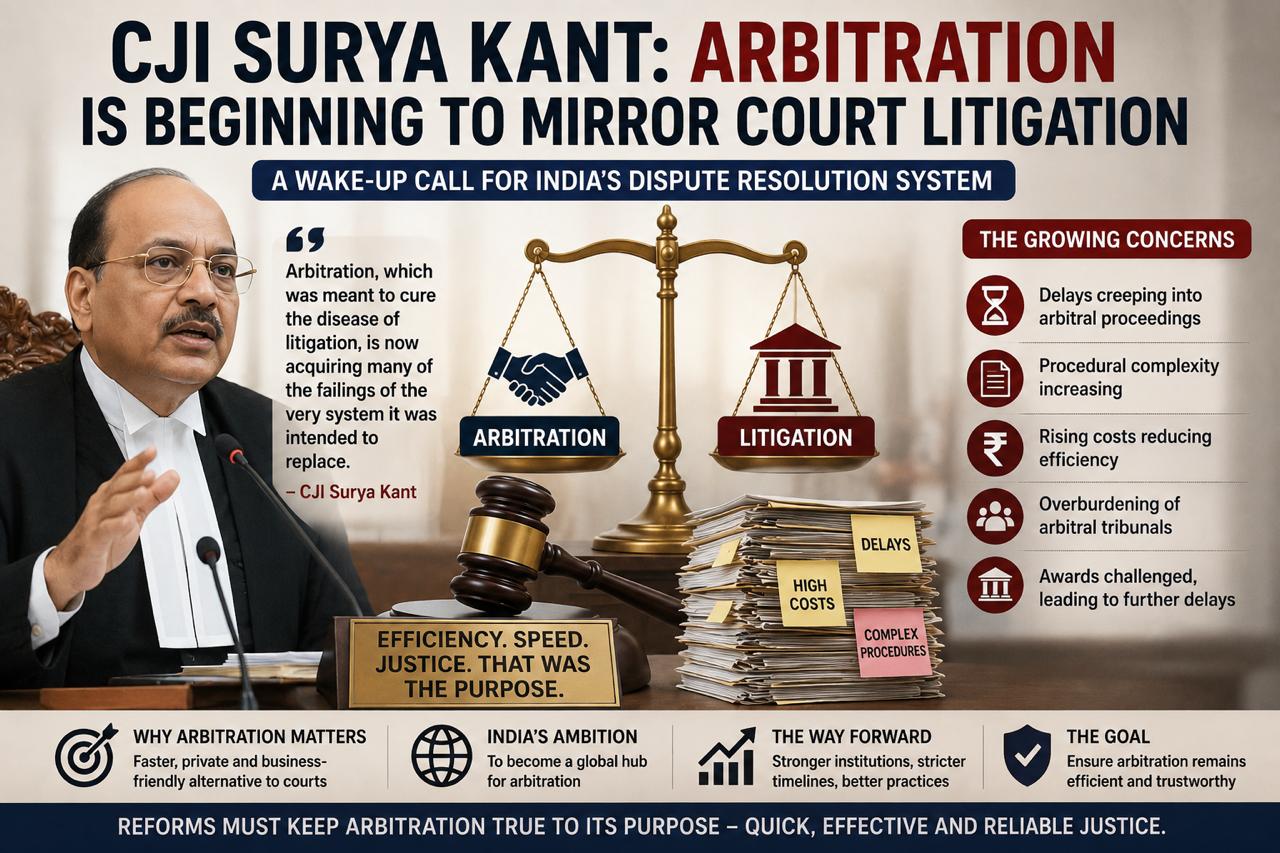
CJI Surya Kant Raises Concerns Over Growing Inefficiencies in Arbitration
Chief Justice of India Surya Kant has expressed concern that arbitration, once viewed as a faster and more efficient alternative to traditional litigation, is gradually beginning to resemble the very system it was intended to replace. His remarks come at a time when India is actively promoting itself as a global hub for commercial dispute resolution and international arbitration.
The Chief Justice observed that arbitration is increasingly exhibiting many of the shortcomings associated with formal court proceedings, including delays, procedural complexity, rising costs, and prolonged dispute resolution timelines. These developments, he suggested, risk undermining confidence in a mechanism that was originally designed to provide quicker and more efficient justice.
Why Arbitration Became Popular
Arbitration gained prominence as an alternative dispute resolution mechanism because it offered parties a private, flexible, and relatively faster way to resolve commercial disputes outside traditional courts. Businesses often preferred arbitration because it promised reduced litigation costs, greater confidentiality, and quicker enforcement of decisions.
Over the past decade, India has introduced several reforms aimed at strengthening its arbitration framework. Legislative amendments, judicial support for limited court intervention, and the establishment of specialised arbitration centres have all sought to improve the country's attractiveness as an arbitration destination.
However, growing procedural complexity is now raising questions about whether arbitration is delivering on its original objectives.
The Growing Challenge of Delays
One of the primary criticisms highlighted by the Chief Justice is the increasing tendency for arbitration proceedings to become lengthy and expensive. What was once intended as a streamlined process has, in some instances, evolved into a dispute-resolution mechanism that closely resembles conventional litigation.
Extended hearings, procedural disputes, repeated adjournments, and challenges to arbitral awards have contributed to delays that reduce the efficiency advantages traditionally associated with arbitration. As proceedings become more complex, businesses may find it increasingly difficult to achieve the swift resolution they initially sought.
The concern is particularly relevant for commercial disputes where time-sensitive decisions can significantly affect business operations and investment outcomes.
India's Ambition to Become a Global Arbitration Hub
India has repeatedly stated its intention to emerge as a preferred destination for international arbitration. Significant reforms have been introduced to improve institutional arbitration, strengthen neutrality standards, reduce judicial interference, and improve enforcement mechanisms.
Despite these efforts, international businesses continue to favour established arbitration centres such as Singapore, London, and Hong Kong for many cross-border disputes. Legal experts have often cited concerns relating to timelines, procedural predictability, and institutional capacity as key factors influencing these decisions.
The Chief Justice's remarks reflect a recognition that legislative reform alone may not be sufficient unless practical implementation also improves.
Implications for Business and Real Estate
The efficiency of arbitration is particularly important for sectors such as real estate, infrastructure, construction, and finance, where contractual disputes can involve substantial investments and long project timelines.
In Mumbai's redevelopment-driven real estate market, arbitration is frequently used to resolve disputes involving developers, contractors, societies, landowners, and investors. Delays in dispute resolution can directly affect project execution, financing, possession timelines, and overall market confidence.
A stronger and more efficient arbitration ecosystem could therefore benefit both the legal system and the broader economy by reducing uncertainty and accelerating dispute resolution.
Institutional Arbitration May Hold the Key
Many experts believe that greater reliance on institutional arbitration can help address some of the challenges currently affecting the system. Institutional frameworks typically provide established rules, administrative oversight, and procedural safeguards that help keep proceedings efficient and predictable.
The continued development of arbitration centres, professional arbitrator training, and stronger procedural discipline may be necessary to ensure that arbitration remains a credible alternative to litigation rather than becoming a parallel version of it.
The success of India's dispute-resolution ecosystem will likely depend on how effectively these reforms are implemented.
What It Means for Investors and Businesses
For businesses and investors, the Chief Justice's remarks serve as an important reminder that dispute resolution mechanisms are a critical part of the investment environment. Companies often evaluate not only market opportunities but also the efficiency of legal and contractual enforcement systems before making major investments.
A robust arbitration framework can improve investor confidence, reduce legal uncertainty, and support economic growth. Conversely, delays and inefficiencies can increase business risks and transaction costs.
Strengthening arbitration therefore remains essential to India's broader economic and commercial ambitions.
Expert View
"Arbitration was created to provide a faster, more efficient alternative to traditional litigation. If it begins to mirror the delays and complexity of court proceedings, it risks losing its greatest advantage. India's next phase of arbitration reform must focus not only on legislation but also on improving institutional efficiency, timelines, and practical implementation." — Sandeep Sadh
Looking to buy or rent in Mumbai?
Talk to Mumbai's oldest property portal — RERA-verified listings, real availability, instant answers.
More Property News









💬 Comments