
Dharavi Redevelopment Is One of India's Biggest Real Estate Execution Tests: HSBC
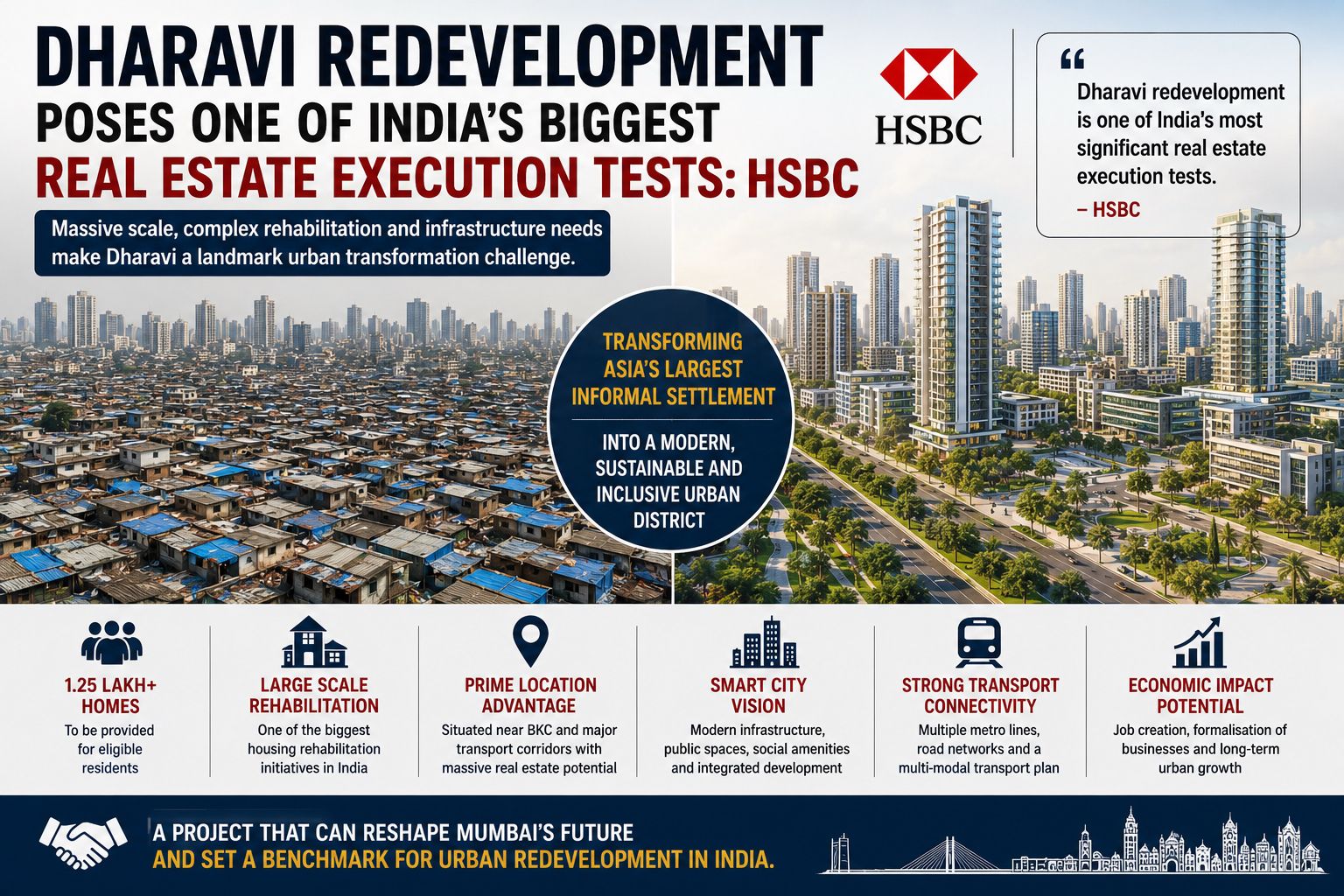
Dharavi Redevelopment Faces One of India's Most Ambitious Urban Transformation Challenges
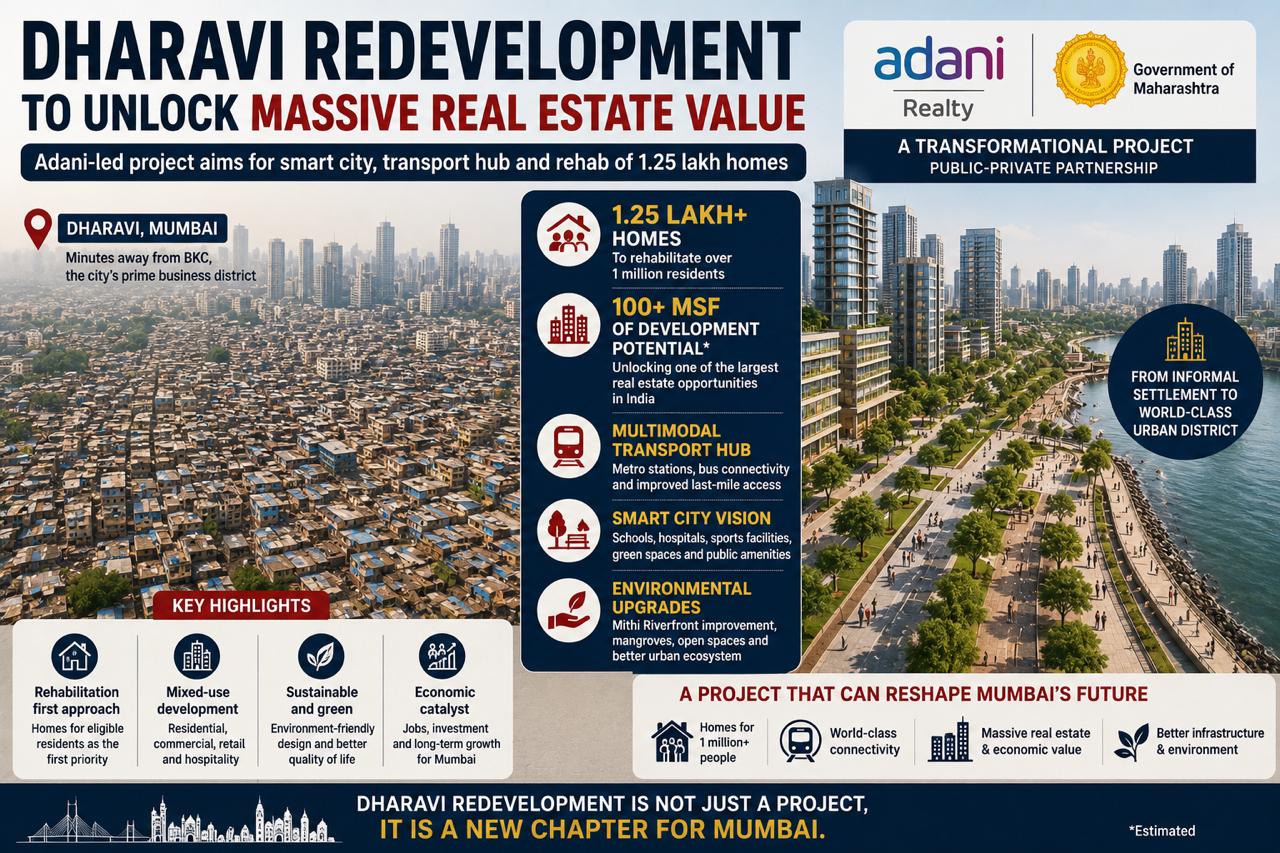
The Dharavi Redevelopment Project has been described by HSBC as one of India's most significant real estate execution tests, highlighting both the enormous opportunities and extraordinary complexities associated with transforming one of Asia's largest informal settlements into a modern urban district.
Spread across a strategically located area in the heart of Mumbai, Dharavi represents far more than a conventional redevelopment project. It combines large-scale rehabilitation, infrastructure creation, commercial development, environmental improvements, and economic revitalisation within a single urban transformation programme.
The scale of the project makes it one of the most closely watched redevelopment initiatives in the country.
Why Dharavi Is Unlike Any Other Redevelopment Project
Most redevelopment projects involve a limited number of buildings or societies. Dharavi, by contrast, involves the rehabilitation and relocation of a vast resident population, the formalisation of thousands of businesses, and the creation of entirely new urban infrastructure.
The project must accommodate residential communities, small industries, commercial establishments, workshops, and informal economic activities that have evolved over decades. This creates an execution challenge rarely seen in Indian real estate.
The complexity lies not only in construction but also in managing social, economic, legal, and logistical considerations simultaneously.
Rehabilitation of Over 1.25 Lakh Homes
A key component of the redevelopment plan involves the rehabilitation of more than 1.25 lakh housing units for eligible residents. The objective is to replace informal housing with modern residential accommodation supported by proper civic infrastructure, sanitation systems, utilities, and community amenities.
Housing rehabilitation on this scale requires extensive surveying, eligibility verification, planning, and coordination between multiple government agencies and private stakeholders.
The successful delivery of rehabilitation housing will be one of the most important indicators of the project's overall success.
Strategic Location Creates Massive Real Estate Potential
One of the reasons the project has attracted national and international attention is Dharavi's location. Situated near Bandra Kurla Complex (BKC), major transportation corridors, and several key commercial districts, the area occupies some of the most strategically valuable land in Mumbai.
Large-scale redevelopment in such a location has the potential to unlock significant residential, commercial, retail, and mixed-use development opportunities. Industry estimates suggest the project could generate substantial long-term economic value while reshaping central Mumbai's urban landscape.
Few redevelopment opportunities of this scale remain available within Mumbai's land-constrained environment.
A Smart City Vision for Central Mumbai
The redevelopment is envisioned as much more than a housing initiative. Plans include modern road networks, public spaces, healthcare facilities, educational institutions, recreational infrastructure, commercial districts, and integrated transit systems.
The project aims to create a sustainable and well-planned urban environment that improves living standards while supporting future economic growth.
Urban planners view the redevelopment as an opportunity to demonstrate how large-scale regeneration can transform underutilised areas into productive and connected city districts.
Transport Infrastructure Will Play a Critical Role
Connectivity forms a central pillar of the redevelopment strategy. Multiple metro corridors, improved road infrastructure, bus networks, and multimodal transportation links are expected to strengthen Dharavi's integration with the rest of Mumbai.
Improved mobility can significantly enhance accessibility for residents, businesses, and future developments. Infrastructure investments often act as powerful catalysts for property appreciation and economic activity.
The success of the redevelopment will depend heavily on how effectively transport infrastructure is integrated into the broader urban plan.
Execution Challenges Remain Significant
While the project's potential is immense, its execution presents substantial challenges. Large-scale rehabilitation requires consensus building, careful planning, and sustained coordination among numerous stakeholders.
Eligibility verification, relocation planning, rehabilitation delivery, infrastructure development, environmental management, and financing all represent critical components that must progress in a coordinated manner.
The project's scale means that execution risks are significantly higher than those associated with conventional redevelopment schemes.
Economic Benefits Could Be Transformational
If successfully executed, the Dharavi Redevelopment Project could generate substantial economic benefits for Mumbai and Maharashtra. Construction activity, infrastructure creation, commercial development, and new business opportunities could support employment generation and attract additional investment.
The redevelopment may also contribute to improved public health, enhanced civic infrastructure, and increased economic productivity by formalising large sections of the local economy.
The project's impact is therefore expected to extend far beyond the real estate sector alone.
What It Means for Mumbai's Future
Dharavi's transformation represents one of the most important urban development opportunities available to Mumbai. The project has the potential to address housing challenges, improve infrastructure, unlock valuable land resources, and create a model for future large-scale redevelopment across India.
However, its ultimate success will depend not on planning alone but on sustained execution over many years. The ability to balance rehabilitation, infrastructure development, commercial viability, and community welfare will determine whether the project achieves its ambitious objectives.
For Mumbai, the redevelopment could become one of the defining urban transformation stories of the coming decades.
Expert View
"Dharavi is not simply a redevelopment project; it is a city-building exercise. The scale of rehabilitation, infrastructure creation, and economic integration required makes it one of the most complex real estate execution challenges India has ever undertaken. If delivered successfully, it could become a global benchmark for urban regeneration." — Sandeep Sadh
Looking to buy or rent in Mumbai?
Talk to Mumbai's oldest property portal — RERA-verified listings, real availability, instant answers.
More Property News
💬 Comments