
Metro Corridors vs Ring Roads: Which Infrastructure Investment Drives Higher Property Appreciation?
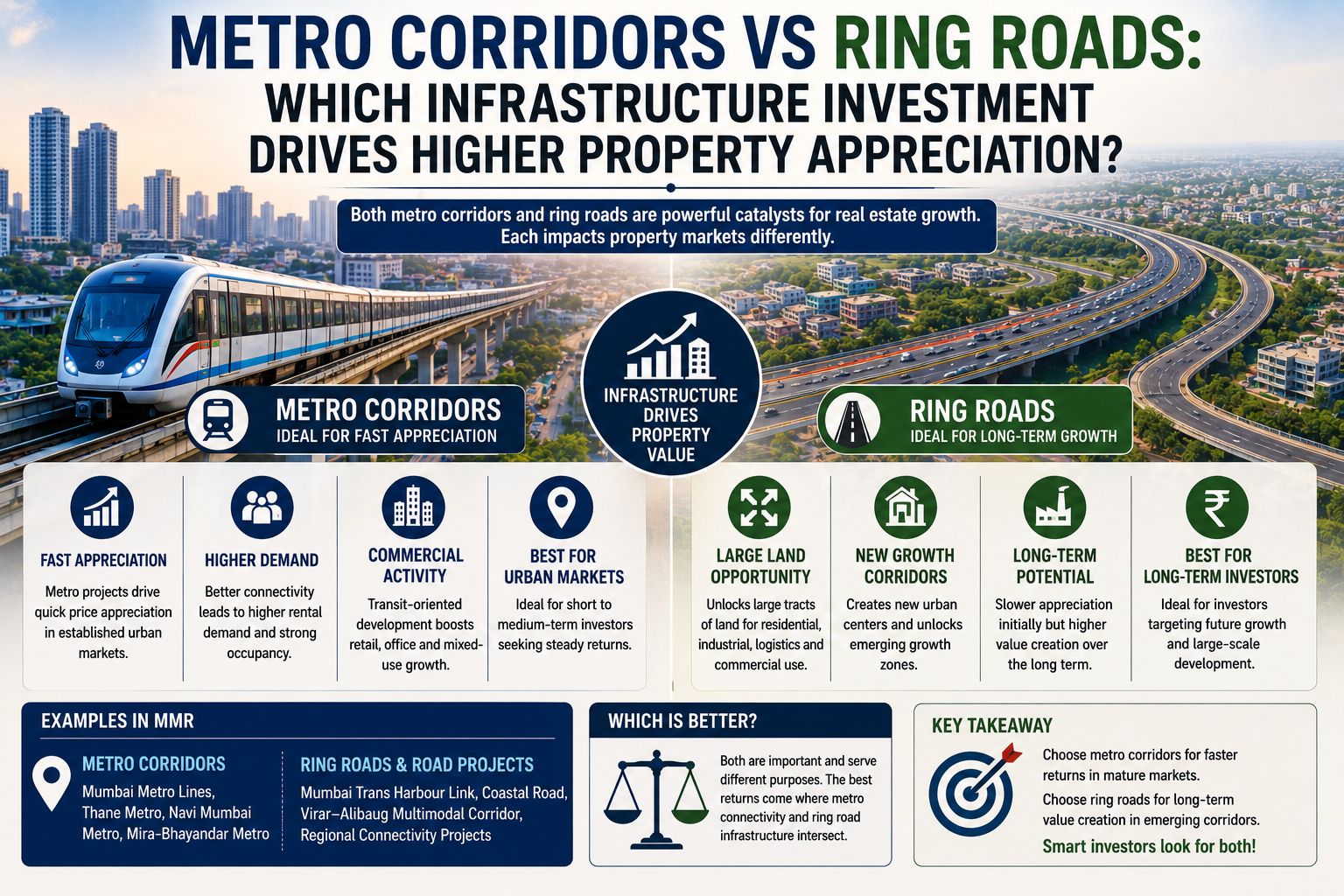
Infrastructure Has Become the Biggest Driver of Property Values
In today's real estate market, infrastructure often influences property prices as much as location itself. Across India, two types of infrastructure investments have consistently reshaped property markets — metro rail corridors and ring roads.
Both improve connectivity, reduce travel times, and stimulate economic activity. However, investors frequently ask an important question: which infrastructure investment generates greater property appreciation?
The answer depends on factors such as location, market maturity, population density, and the stage of urban development. While metro corridors tend to create rapid appreciation within established urban centres, ring roads often unlock entirely new growth zones and create long-term development opportunities.
Understanding the strengths of each can help investors make better real estate decisions.
Why Metro Corridors Boost Property Values
Metro rail systems are designed to improve urban mobility by providing fast, predictable, and high-capacity transportation. By reducing travel times between residential areas and employment hubs, metro corridors make locations more attractive to both homebuyers and businesses.
Properties located within walking distance or a short commute from metro stations often witness higher demand because residents value convenience and reduced commuting costs.
The effect is particularly strong in densely populated cities where road congestion significantly impacts daily travel.
Numerous studies across Indian cities have shown that residential and commercial properties near metro stations often command a premium compared to similar properties located farther away.
Transit-Oriented Development Creates Demand
One of the biggest advantages of metro infrastructure is its ability to create transit-oriented development. Retail centres, office spaces, residential towers, hotels, and mixed-use developments tend to cluster around major metro stations.
As footfall increases, commercial activity grows, attracting businesses and investors. This concentration of activity often creates a self-reinforcing cycle of appreciation.
In cities such as Mumbai, Bengaluru, Delhi, Hyderabad, and Pune, metro corridors have become some of the most sought-after real estate locations.
For investors seeking rental income, metro-connected properties often enjoy stronger occupancy levels and higher tenant demand.
How Ring Roads Transform Entire Growth Corridors
While metro systems improve mobility within existing urban areas, ring roads operate differently. Their primary purpose is to decongest city centres by creating alternate transportation routes around metropolitan regions.
By improving regional connectivity, ring roads open up large tracts of previously underdeveloped land for residential, commercial, industrial, and logistics development.
This expansion effect can significantly increase land values across suburban locations that were once considered too distant or inaccessible.
In many cases, ring roads create entirely new urban growth corridors rather than simply improving existing neighbourhoods.
Ring Roads Unlock Large-Scale Development
One of the greatest advantages of ring roads is the availability of land. Since development occurs along newly connected corridors, developers often gain access to larger parcels suitable for integrated townships, industrial parks, warehousing hubs, logistics centres, and mixed-use communities.
The appreciation cycle may initially be slower than metro-led growth, but the long-term upside can be substantial because development occurs across much larger areas.
Cities such as Hyderabad, Bengaluru, Pune, Ahmedabad, and Nagpur have witnessed significant real estate expansion driven by ring-road infrastructure.
For long-term investors, these emerging corridors often provide opportunities to enter markets before major price appreciation occurs.
Metro Corridors Deliver Faster Appreciation
In general, metro infrastructure tends to generate quicker property appreciation because it directly improves daily commuting convenience for existing populations.
The impact is often visible shortly after project announcements, with prices increasing further as construction progresses and stations become operational.
Residential buyers, tenants, and businesses are usually willing to pay a premium for immediate connectivity benefits.
As a result, metro-driven markets often experience faster demand growth, stronger rental yields, and more rapid capital appreciation.
This makes metro-linked properties particularly attractive for short- to medium-term investors.
Ring Roads Offer Greater Long-Term Potential
Ring roads typically create value over a longer time horizon. Instead of benefiting a few neighbourhoods, they influence entire urban regions.
As infrastructure develops, land use changes, employment hubs emerge, and new residential communities are established. Over time, these areas can evolve into major urban centres in their own right.
Investors with a longer investment horizon often benefit from entering ring-road corridors during the early stages of development when prices remain relatively affordable.
The appreciation cycle may take longer, but the scale of growth can be significant.
What This Means for Mumbai Metropolitan Region
The Mumbai Metropolitan Region provides examples of both infrastructure-driven growth models. Metro lines across Mumbai, Thane, Navi Mumbai, and Mira-Bhayandar are already influencing residential demand and property values.
At the same time, major road infrastructure such as the Mumbai Trans Harbour Link, Coastal Road, Virar-Alibaug Multimodal Corridor, and various regional connectivity projects are creating new growth corridors across the metropolitan region.
Areas benefiting from both metro connectivity and regional road infrastructure are likely to experience the strongest long-term appreciation.
The combination of improved mobility and expanded development potential often creates powerful real estate growth drivers.
Which Infrastructure Investment Is Better?
There is no universal answer because both serve different purposes.
Metro corridors generally deliver:
- Faster price appreciation
- Higher rental demand
- Stronger commercial activity
- Better performance in established urban markets
Ring roads generally deliver:
- Larger land value creation
- New development opportunities
- Township and industrial growth
- Stronger long-term expansion potential
For investors seeking immediate demand and rental income, metro-connected locations may offer greater advantages. For those targeting long-term capital appreciation and emerging growth corridors, ring-road developments may provide superior opportunities.
The strongest investments are often located where both forms of infrastructure intersect.
Expert View
"Metro corridors and ring roads should not be viewed as competing investments but as complementary growth drivers. Metro projects typically create faster appreciation in mature urban markets, while ring roads unlock entirely new development zones. The most successful real estate investments are often located where high-quality public transport and regional road connectivity come together." — Sandeep Sadh
Looking to buy or rent in Mumbai?
Talk to Mumbai's oldest property portal — RERA-verified listings, real availability, instant answers.
More Property News





💬 Comments