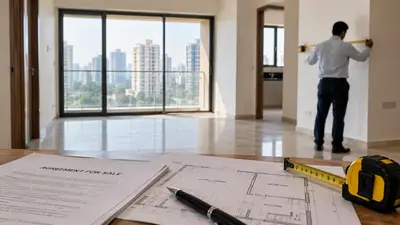
Buying an under-construction home in Mumbai? Know what you're getting into — before you sign.
The honest answers to every question buyers ask us — schemes, loans, land types, society costs, builder delays and how to protect yourself. Don't book off a phone call. Understand, then decide.
Under-construction basics & ROI
What is an under-construction property and how does buying one work?
It's a home you book before completion — sometimes at launch, sometimes mid-construction. You pay a booking amount, sign an agreement registered under MahaRERA, and pay the balance in stages as the building rises. You get possession on completion, with an Occupancy Certificate (OC).
What are the benefits of buying under-construction?
Typically a lower entry price than a ready flat in the same project, staggered payments (you don't need the full amount upfront), wider choice of unit, floor and view, and a longer appreciation runway — the price often rises between launch and possession. You also get a brand-new home under warranty.
How does ROI / appreciation on under-construction actually work?
Your return comes from the gap between your entry price and the market price at (or after) possession, amplified by leverage — you've often paid only 20–40% while the whole asset appreciates. But it's not guaranteed: returns depend on the micro-market, the builder delivering on time, and the cycle. A delayed or stuck project can wipe out the paper gain.
We model the realistic appreciation for a specific project against its locality's actual registered rates — not the builder's projection.
Under-construction vs ready-to-move — which is right for me?
Under-construction = lower price, payment flexibility, but you wait and carry delay/quality risk. Ready-to-move = you see exactly what you get, no GST, immediate rental/use, but costs more. End-user needing a home now often leans ready; an investor with time horizon often leans under-construction.
Payment schemes & home loans
What is the 20:80 scheme?
You pay ~20% upfront and the remaining 80% on possession (or a later milestone). It eases cashflow and delays your big outflow. The catch: the builder usually prices this in, and if a bank/subvention funds the 80%, watch the interest mechanics carefully.
What is a subvention scheme?
In a subvention scheme the builder pays your loan's pre-EMI interest until possession (or a fixed date) — so you put down a small amount and pay nothing more until you move in. Attractive, but the cost is built into the flat price, and if the builder stops paying or delays, the EMI burden lands on you. RBI has tightened these, so read the tripartite agreement carefully.
Subvention and 20:80 deals change often and aren't published — ask us for the live, genuine schemes on any project.
Construction-linked vs time-linked payment plans?
Construction-linked (CLP): you pay as each slab/stage is completed — safer, because payment follows progress. Time-linked: you pay on fixed dates regardless of progress — riskier if the builder slows down. Prefer construction-linked where possible.
What is pre-EMI, and how does a home loan work for under-construction?
The bank disburses your loan in tranches as construction progresses, not in one shot. Until full disbursement you pay pre-EMI — interest only on the amount disbursed so far (principal repayment starts after full disbursement / possession). So your outflow ramps up over the build. Factor pre-EMI into your monthly budget — it runs alongside any rent you're still paying.
What about GST, stamp duty and registration?
Under-construction homes attract GST (ready homes with OC don't). You also pay stamp duty + registration on the agreement value. These are real costs on top of the flat price — we'll give you the all-in number before you commit.
Land & project type — and what it means for your price
What is redevelopment, and should I buy in a redevelopment project?
An old society is demolished and rebuilt, usually by a developer who gives existing members new flats plus sells the extra "saleable" flats. Upside: prime locations, modern building. Watch: society/member consent, the development agreement, and timelines — redevelopments can stall on internal disputes.
MHADA, MMRDA, MIDC, SRA land — what's the difference?
MHADA: housing-authority land/lottery stock — often leasehold with transfer rules. MMRDA: planning authority for the metropolitan region (e.g. BKC) — typically leasehold, premium. MIDC: industrial land — residential use needs conversion/clarity. SRA: slum-rehabilitation projects, where a developer rehouses slum dwellers and sells free-sale flats.
Will SRA or redevelopment land impact my home's price and resale?
It can. SRA free-sale buildings sometimes carry a perception discount and may share the plot/amenities with the rehab wing, which some buyers and lenders weigh differently — affecting resale liquidity and loan terms. It's not automatically bad (many are well-built in great locations), but you must check the layout, the separation, the lease terms and comparable resale rates. This is exactly where independent research pays for itself.
We tell you the real resale behaviour of SRA/MHADA/leasehold buildings in that micro-market — from actual transactions, not opinion.
Freehold vs leasehold, and OC/CC — why they matter
Freehold = you own the land share outright; leasehold = land is leased (common on MHADA/MMRDA), with renewal/transfer conditions. CC (Commencement Certificate) allows construction; OC (Occupancy Certificate) certifies it's legal to live in — never take possession without OC.
Community, society costs & amenities
Gated community vs standalone building — which should I choose?
Gated community: security, amenities (gym, pool, clubhouse, open space), better resale appeal — but higher maintenance and you pay for facilities you may not use. Standalone: lower outgoings, often more central, more land-efficient — but fewer amenities and sometimes weaker resale narrative. Families and end-users often prefer gated; value/location-first buyers often prefer standalone. Match it to how you'll actually live.
What are society outgoings / maintenance, and what should I expect?
Monthly charges for upkeep, security, amenities, sinking fund and property tax share. Amenity-heavy gated projects cost more per sq ft per month than simple buildings. Always ask the expected outgoing before buying — on a large flat it's a meaningful recurring cost.
Risk & how to safeguard yourself
What happens if the builder delays the project?
Under RERA, the promoter must hand over by the registered possession date or pay you interest/compensation for the delay; you can also seek a refund with interest if you withdraw. Funds are meant to sit in a RERA escrow account (70% of collections) used only for that project. But enforcement takes effort — which is why the project you pick matters more than the remedy.
How do I safeguard myself before booking?
Verify the MahaRERA registration and read the project's filings (approvals, litigation, timelines). Check title and approvals, insist on a construction-linked plan, confirm the escrow account, scrutinise the agreement's delay/exit clauses, and never pay large sums before registration. Check the builder's delivery track record, not just the brochure.
Every project page on MPE shows its live MahaRERA status, possession dates, litigation flag and unit absorption — the facts, before the sales pitch.
How do I verify a project on RERA?
Every genuine project has a MahaRERA registration number disclosing the promoter, approvals, sanctioned plan, financials, complaints and revised timelines. If a project isn't RERA-registered, or the number doesn't check out, walk away. We surface this data on every project we list.
Choosing a builder — and not booking blindly
Which builder, and how many projects — how do I judge?
Look at how many projects they've delivered, on time, and how they've held value on resale — not how glossy the launch is. A builder with a long delivered track record in that micro-market is worth a premium over an unproven name offering a "deal".
We hold the data on builders across Mumbai — projects, delivery history and absorption — so you choose on evidence.
Someone keeps calling/SMSing me about a project — should I just go?
No. A cold call or SMS is a sales pitch, not advice — they earn when you buy their inventory, not when you buy right. Before you visit any site, get an independent read: is the price fair versus the locality, is the builder sound, is the scheme genuine, is the timing right for you? That's what we do — we research, then assist.
Don't decide alone. Get 30 years of judgment on your side.
Tell us the project you're considering — we'll give you the rates, the builder's record, the real scheme, and an honest "buy / wait / avoid".
💬 Ask our advisor on WhatsApp